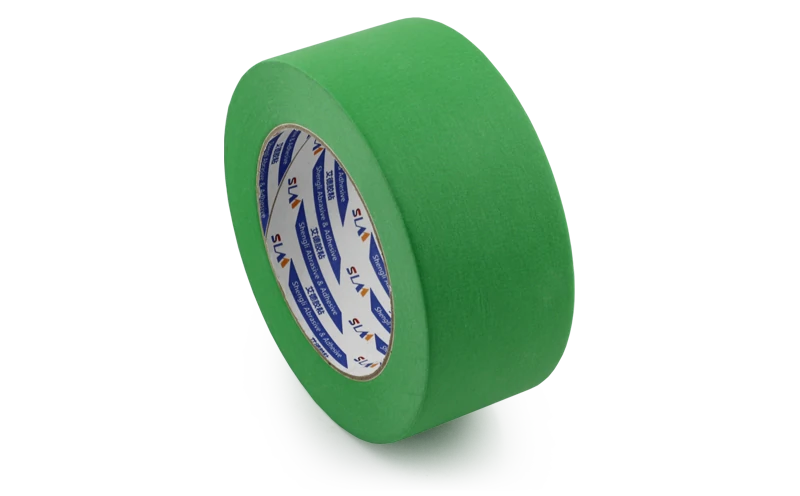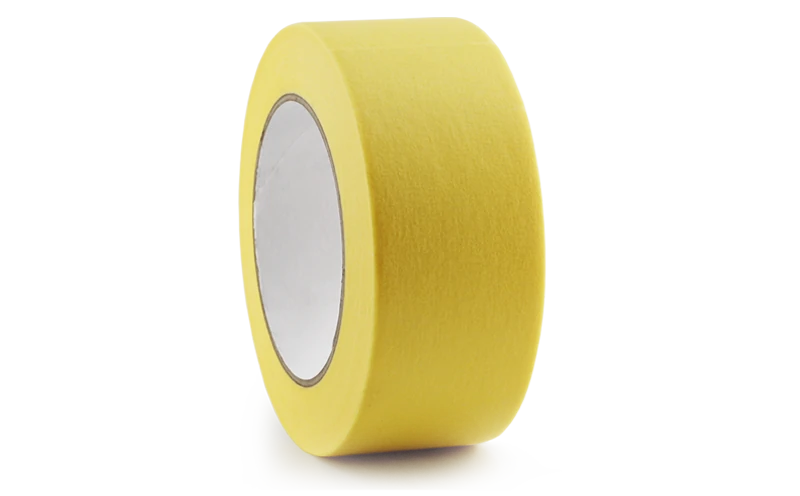
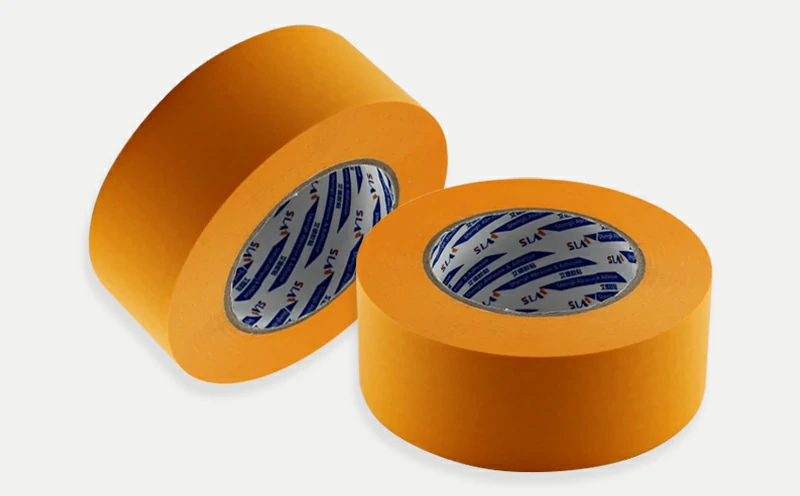
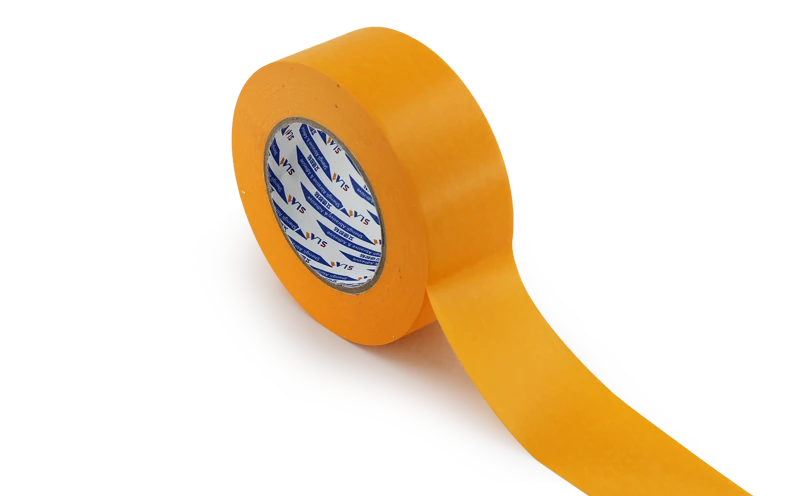
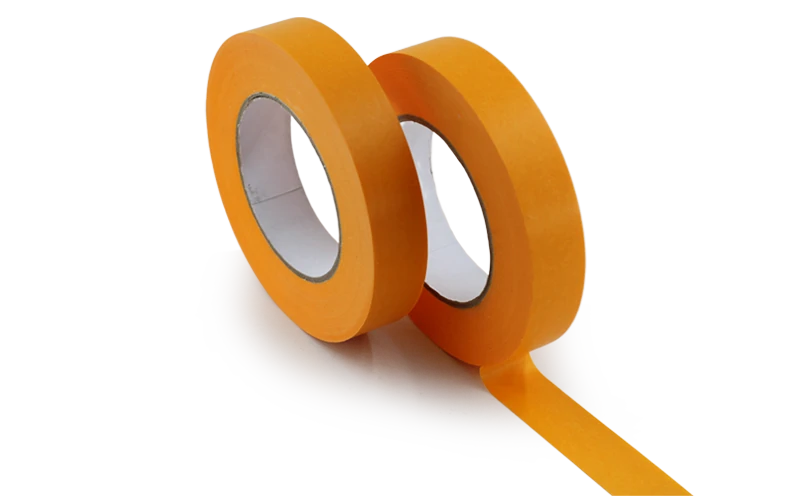
Sandblasting Masking Tape is an industrial-strength, high-density surface protection solution engineered specifically to withstand the extreme friction and destructive force of abrasive blasting. Constructed with a heavy-duty, impact-resistant flat paper backing and coated with a high-tack natural rubber adhesive system, this premium masking tape serves as a reliable protective barrier and stencil medium. It blocks aggressive blast streams from penetrating sensitive areas, delivers immaculate color/texture boundaries, and peels away cleanly without leaving behind stubborn adhesive residues or ghosting patterns.
In architectural stone-cutting, precision glass etching, and automotive restoration, standard paper tapes fail almost instantly—the intense mechanical friction from high-pressure blast media pulverizes thin backings, resulting in ruined profiles and damaged substrates. SLAA's specialized Sandblasting Masking Tape provides an engineered sacrificial layer designed to absorb high-velocity impacts. The dense flat paper carrier balances high tensile strength with dimensional stability, allowing it to act as an unyielding stencil that preserves sharp, factory-grade lines on mirrors, glass sheets, memorials, and industrial metals during intricate sandblasting masking protocols.
A core performance driver of this Sandblast Tape is its heavy-weight natural rubber pressure-sensitive adhesive. Formulated with high initial grab and exceptional shear resistance, the adhesive anchors tightly to smooth, polished, and irregular surfaces alike. This tight mechanical seal creates a flawless barrier that effectively stops fine abrasive dust, aluminum oxide, glass beads, or steel shot from creeping underneath the edges (under-cutting). Despite its rugged holding strength during active blasting and industrial paint stripping, the tape is conveniently hand-tearable to streamline field workflows and removes cleanly from sensitive substrates without tearing or shredding into frustrating fragments.
To accommodate diverse project scales—ranging from intricate micro-etching to expansive structural shot blasting—we offer flexible, custom-slit sizing matrices. Rolls can be precision-cut into widths spanning from narrow 5mm strips for fine graphic pinstriping up to massive 1000mm master rolls for broad architectural masonry layouts, supplied in standard, high-efficiency lengths of 25 meters or 50 meters.
|
Total thickness ( mm ) |
0.20 |
|
Adhesive |
Natural rubber |
|
Carrier |
Flatback paper |
|
Adhesion ( N/25mm ) |
5 |
|
Tensile strength ( N/25mm ) |
225 |
|
Ball tack ( cm / Ball No. 20 ) |
19 |
|
Temperature resistance 1h/℃ |
110 |
|
Hand tearability |
Yes |
Q1: Why should I use this flat paper Sandblasting Masking Tape instead of standard paper masking tapes?
A: Standard utility masking tape is far too thin and fragile; a pressurized blast stream will chew through it in fractions of a second, destroying the surface underneath. Our specialized Sandblast Tape utilizes a high-caliper, impact-dense flat paper backing engineered to absorb the localized kinetic energy of flying blast grit, acting as a true sacrificial shield.
Q2: Will the high-tack natural rubber adhesive leave a sticky film behind on delicate glass or polished stone?
A: No. While the natural rubber adhesive delivers an aggressive initial bond to keep lines airtight against grit under-creep, it is formulated with high internal cohesive strength. This means the adhesive layer prefers to stick to its paper backing rather than the substrate, ensuring it lifts away cleanly without ghosting or leaving sticky residues.
Q3: What types of blasting media can this Sandblasting Masking Tape successfully resist?
A: It is highly versatile and performs exceptionally well across standard light-to-medium abrasive cleaning setups, including glass glass-bead blasting, walnut shell media blasting, plastic media blasting, aluminum oxide etching, and standard sand/grit procedures. For ultra-heavy industrial steel shot blasting at high pressures, we recommend testing a multi-layer tape layup or exploring our extra-thick rubber sandblast stencils.
Q4: Can this tape be cut smoothly using a plotter machine or a stencil laser?
A: Yes. Because it uses a dense flat paper design rather than stretchy rubber membranes, it cuts crisp and clean without gummy build-up on blades. This makes it a popular choice for sign shops and stone carvers who execute complex geometric stencils or fine lettering using computerized cutting equipment.